
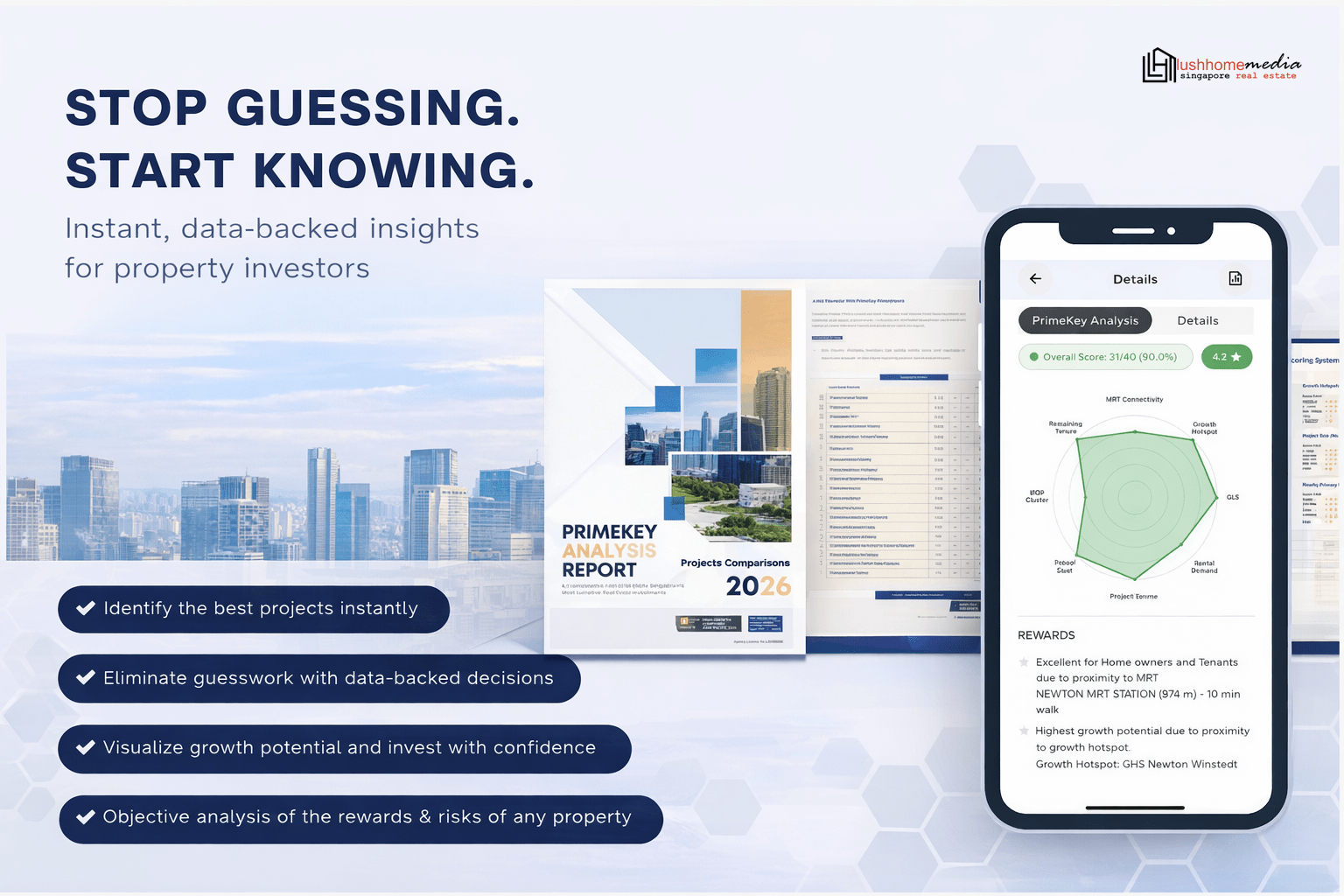
Buying a home is one of the biggest financial and lifestyle choices you will ever make. Yet many buyers still rely on showflat impressions, sales narratives or gut feel when deciding what to buy, where to buy, and when to act. PrimeKey Analysis was created to change that.
What PrimeKey actually does for you
PrimeKey Analysis is a structured framework used within the Navis Atlas platform to assess the long‑term quality, risk and investment strength of a property. It condenses eight proven drivers of price growth, rental demand and resale liquidity into a single, easy‑to‑read score and colour band.
Instead of guessing, you see clearly how strong a property’s fundamentals are and how it compares with other options across Singapore. The goal is simple: to help you make property decisions with clarity, confidence and foresight—not emotion.
Making decisions without the hype
Good layouts, tasteful interiors and glossy marketing can make almost any project look attractive. But these visible features often say very little about how a property will perform five, ten or fifteen years from now.
PrimeKey shifts your attention from surface details to deeper fundamentals that drive long‑term value. It helps you answer questions like:
- Will this home still be easy to resell when I need to upgrade or cash out?
- Will tenants continue to want this location?
- Am I over‑paying for convenience today but taking on hidden risks tomorrow?
By focusing on data‑backed drivers instead of sales pitches, you understand not just what you are buying—but what you are buying into.
The eight PrimeKey pillars in plain language
PrimeKey scores every property across eight pillars. Together, they paint a clear picture of its future resilience and upside.
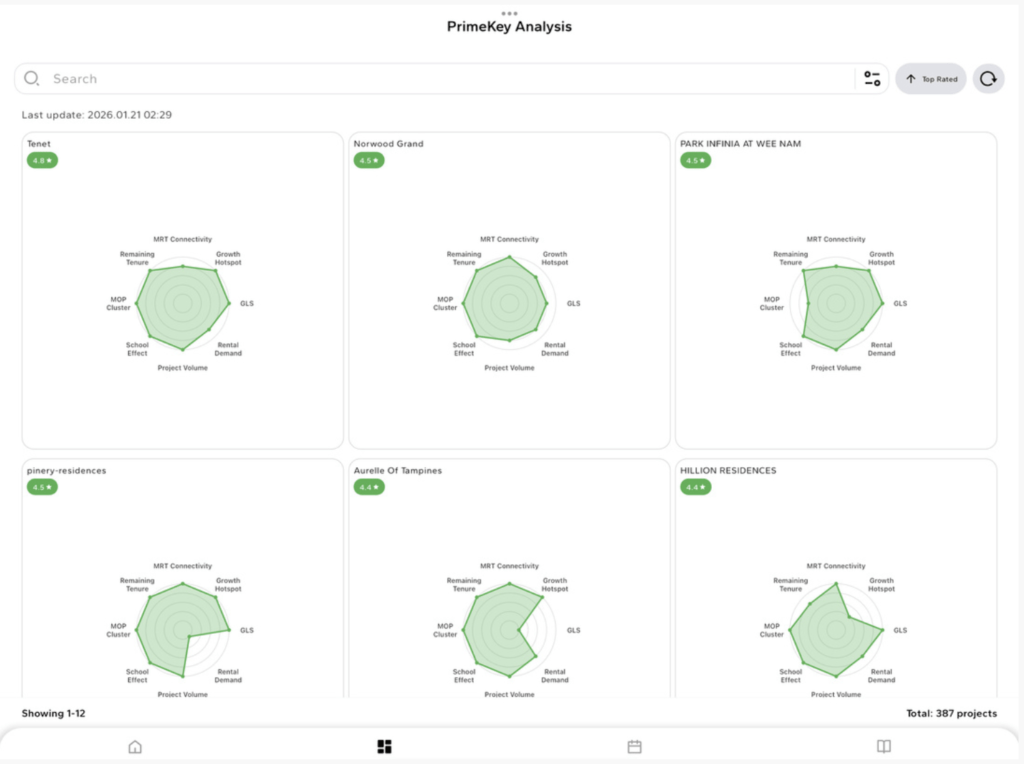
1. MRT connectivity: real‑world convenience
Proximity to the MRT is one of the strongest drivers of both rental and resale demand. Homes within a comfortable walk to a station consistently attract a wider pool of tenants and buyers, and tend to hold prices better in weaker markets.
PrimeKey looks at actual walking time (not just “near MRT” in brochures), because for most people convenience is not a trend—it is a permanent preference. The closer and more accessible the MRT, the lower your vacancy risk and the more stable your long‑term demand.
2. Growth hotspots: riding urban transformation
In Singapore, some of the most significant price gains have followed government‑led transformation areas highlighted in the URA Master Plan. These growth hotspots benefit over time from new transport links, commercial hubs, parks and lifestyle amenities.
PrimeKey checks if your property falls within or close to these zones. Buying into a genuine growth corridor means you are positioned to benefit as the neighbourhood improves, instead of paying top dollar in a fully mature area with limited room for further uplift.
3. Government Land Sales: understanding future supply
Future supply shapes future prices. When nearby Government Land Sales (GLS) sites are released progressively, new launches usually come at higher prices due to rising land and construction costs. These launches often set new benchmarks that support the value of earlier projects in the same cluster.
PrimeKey examines the GLS pipeline around your property, so you see beyond today’s supply and understand how the local market is likely to evolve over the next cycle.
4. Project size: scale, livability and exit options
The size of a development quietly affects maintenance costs, facilities quality, transaction volume and resale liquidity.
Larger projects usually enjoy better economies of scale, more complete facilities, and more frequent transactions—which in turn support bank valuations and buyer confidence. Smaller boutique developments may feel exclusive, but often face higher per‑unit costs and thinner resale activity, making exits harder.
PrimeKey factors this in by asking a key question: does this project have enough scale to remain competitive and attractive over time?
5. Remaining tenure: the health of your lease
For leasehold homes, remaining tenure is not just a number—it is a crucial driver of both price and financing. As leases shorten, depreciation accelerates and banks become more conservative with loans, shrinking your future buyer pool.
PrimeKey assesses whether a property still has a healthy runway before it enters the phase where lease decay and financing restrictions significantly raise your resale risk. This helps you avoid situations where prices look stable on the surface, but underlying value is slowly eroding.
6. Nearby primary schools: built‑in family demand
Being within 1 km of primary schools, especially popular ones, creates consistent demand from families who want to boost their children’s chances of securing a place. This “parent‑driven” demand tends to persist regardless of market cycles.
PrimeKey doesn’t treat school proximity as a lifestyle perk—it treats it as a structural demand driver that supports price resilience and liquidity. The more schools within that 1 km band, the more robust and repeatable the demand.
7. HDB upgrader demand: your future buyer pool
A successful purchase always considers your eventual exit. In many estates, a large portion of future private‑property buyers are HDB owners whose flats have reached Minimum Occupation Period (MOP).
PrimeKey identifies neighbourhoods with substantial numbers of MOP‑ready flats, signalling a strong pool of young, financially capable upgraders who prefer to remain within the same area. This upgrader demand provides important price support and improves your odds of selling at a fair value when you are ready to move on.
8. Rental demand and yield: defensive strength
Even if you buy mainly for own stay, rental performance matters. Strong rental demand improves cash flow if you choose to rent out, gives you holding power in tougher times, and draws investor interest at resale.
PrimeKey benchmarks rental yields against realistic ranges for the Core Central Region (CCR), Rest of Central Region (RCR) and Outside Central Region (OCR), so expectations stay grounded in actual market behaviour—not wishful thinking.
Reading the PrimeKey score and colours
After assessing all eight pillars, PrimeKey consolidates them into an overall score and a colour band that summarises the property’s risk‑reward profile:
- Green – Strong fundamentals, lower risk, and an investment‑grade profile.
- Yellow – Balanced, generally sound, with some trade‑offs that you should understand and accept.
- Orange – Elevated risks or weaknesses in several pillars; suitable only with clear strategy and careful consideration.
- Red – Structural issues that can seriously impact long‑term performance; proceed only if there is a compelling personal reason or significant price discount.
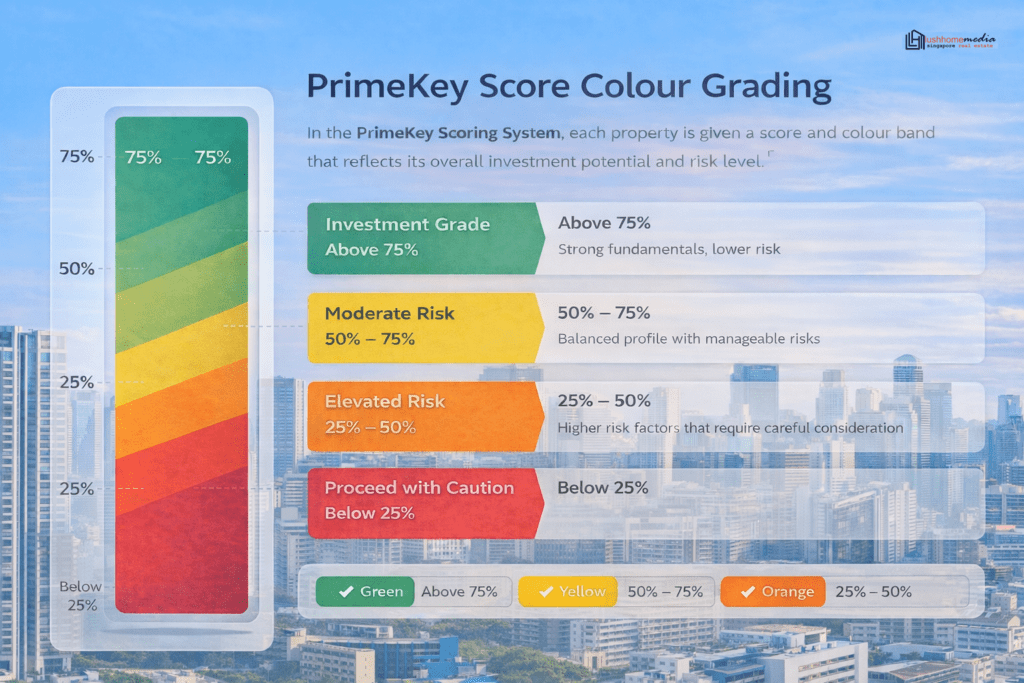
Two projects may look equally attractive today, but their PrimeKey colours can reveal very different long‑term stories when you compare what is driving their scores.
How to use PrimeKey as a buyer
PrimeKey does not dictate what you must buy; it clarifies what you are walking into. A simple way to use it in your property journey:
- Start with your shortlist
Choose projects that already fit your budget, layout preferences and lifestyle needs. - Check their PrimeKey scores
See which homes are Green or strong Yellow, and note which pillars are driving those strengths or weaknesses. - Ask the right questions
- If a project scores lower on tenure, are you prepared for earlier resale constraints?
- If MRT connectivity is weaker, does the price fairly compensate for that trade‑off?
- If rental demand is only moderate, can you comfortably service the loan without relying on high rent?
- Decide with intent, not emotion
Use strong scores as reassurance, and weaker scores as a prompt to negotiate harder, adjust expectations or walk away.
What PrimeKey ultimately gives you
PrimeKey Analysis gives you a calm, structured way to buy property in a market that is often noisy and emotional. It turns scattered data points into a clear narrative of risk and potential, so you can:
- Compare very different projects on an apples‑to‑apples basis.
- Uncover hidden risks before signing on the dotted line.
- Buy with confidence that your decision is both lifestyle‑friendly and financially prudent.
In property, nobody can predict the future perfectly. But you can greatly reduce avoidable mistakes. PrimeKey exists to help you do exactly that—so your next home is not just a place you love, but a decision you can stand by for years to come.
If you are planning a move or investment and want to see how your shortlisted properties score on PrimeKey, reach out to us. We will walk you through a full PrimeKey Analysis and help you compare projects side by side before you commit. Contact us today to schedule a personalised PrimeKey consultation and make your next property decision with clarity, confidence and peace of mind.
Need an opinion on your property investment plans, the best buys available today or help marketing your properties?
Get a 1-time free Property Wealth Planning (PWP) consultation with Lushhome Property Wealth Planners.
A PWP consultation includes:
– An in-depth financial affordability assessment and timeline planning
– Has your property stagnated or dropped in price? What options do you have?
– Highly relevant investment insights on the current and long term property market
– A clear and customised investment road map to fulfil your dreams and life goals
– A curated list of best buys in today’s market with good growth potential, minimal risks and long term exit strategies
– Selecting units with the highest potential in a new launch project
– Advice on marketing and getting a buyer for your property fast
Follow us on Instagram or Facebook, or Whatsapp us now for any enquiries.
—
While this article has endeavoured to ensure that the information and materials contained herein are accurate and up to date as at [9/2/2026], Lushhomemedia.com is not responsible for any errors or omissions, or for the results obtained from their use or the reliance placed on them. All information is provided “as is”, with no guarantee of completeness, and accuracy.